Pages

Showing posts with label feminism. Show all posts

Monday, February 16, 2015

This is What a Feminist Looks Like

On how we can elevate the pop dialogue about feminism

Lately, there's been a pattern repeatedly taking place in the pop-o-sphere. A reporter asks a woman (usually a young actress) if she's a feminist.

If she says, "Yes, unequivocally," there's some cheering from the feminist camp and some grumbling from others about how she probably hates men (or if she says more than that, she could be subjected to online terror like name-calling, threats, and doxxing). And a lot of people will comment on how she looks.

If she says something like, "Well, I believe in equal rights but I don't think I'd consider myself a feminist because, you know, I like men," then a bunch of people shout at her that believing in equal rights makes her a feminist and isn't she ignorant. And a lot of people will comment on how she looks.

Sometimes men are asked if they're feminists, and a lot of the time they're all: "Yeah, my mom/girlfriend/wife/sister is a really strong woman." Then everyone goes, aww, that's so sweet.

I'm glad that the word "feminism" is getting play in the popular dialogue, but now that it's having a moment, it's time to elevate the conversation. The types of dialogue described above help no one. At least, no women. Whether women do or do not claim feminism, they face ridicule or worse.

So how can we shift the conversation in a more productive direction?

1) Avoid reductionism


When Gina Rodriguez was asked if she was a feminist
and said no, this was the reply.
I love how open-minded Gina is,
but wonder if we're making
being a "feminist" too simple.

Photo credit: here.

I've noticed a trend of people claiming that feminism just means "equal rights" for women, so if you believe in equal rights, you're a feminist. While that is one way the dictionary defines feminism, for most feminists, the movement goes beyond equal rights. 

Let's imagine that we woke up tomorrow and the ERA had passed, and women and men were completely equal under the law. Also, in this magical night, women's paychecks became equal to men's, and all laws that privileged men were taken off the books. Would feminism become unnecessary?
I would argue no, because the cultural patriarchy would still be intact.

If we pass laws so that rapists are prosecuted fully, will that mean we're free from rape culture? If women are given equal rights within the military, will we stop killing women and children in other countries? If men and women are completely equal in marriage, but our lesbian sisters can't marry in all fifty states, are we truly equal?

Besides the fact that feminism is about more than just equal rights (although it's definitely about that), there are lots of different brands of feminism... as many as there are women. 

So let's stop trying to convince women who don't identify as feminists that they are "really" feminists by getting them to accept a reductionist definition of a diverse and complicated movement. Instead, let's engage others in a dialogue about what the systems of patriarchy really are, how they are intertwined in all aspects of our society, and how we can work together to dismantle them.

2) Don't make it about dudes

Look, as a straight feminist woman, does my heart go pitter-pat when I see a favorite male celebrity wearing a feminist-themed t-shirt? Sure. 


Do you think, "I'm attempting to
dismantle patriarchy" would fit
on a shirt?

Photo credit: Elle UK
However, feminism isn't about guys. The fact that we make it about the benefits guys will reap from dismantling patriarchy is just evidence of how our society defaults to men's voices, even when we're talking about lady stuff.

First, while it's great that campaigns like #heforshe point out that patriarchy hurts men as well as women, we need to make it OK to argue that even if it didn't, we should still dismantle it. We need to argue that it's right and moral to consider women's rights without reference to men's feelings, desires, or needs. You know, because women are people.

Second, I love it that lots of men consider themselves feminists. I believe that men can be feminists, which is in itself sort of controversial among feminists. Yet it has to be the prerogative of women to confer this status on men. Just as, as a White person, it is not my right to name myself an ally to people of color, or as a straight person, to call myself an LGBT ally; men should let women confer allyship to the feminist movement.

Instead of men saying, "I'm a feminist," how about: "I'm trying to be anti-patriarchal." I know it's not as cool on a T-shirt. But it will elevate women's voices and acknowledge that men benefit from the privileges of patriarchy whether they want to or not.

Another way that men can be allies: make the internet safe for all of us to talk about feminism. Call out your brothers who doxx, threaten, and bully women online. Refuse to be silent when other men joke about rape, call for women's submission to men, or when women are called ugly and fat (or beautiful and elegant) in conversations about issues.

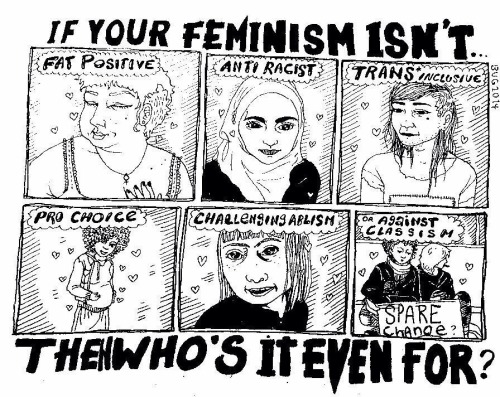
3) Make it inclusive
Photo credit: here (if you know the original illustrator,
please let me know so I can credit!)

I believe that the patriarchy is deeply embedded in a system that is White supremacist, hetero-
normative, and oppressive to well... do you have all day? 

Yet feminism often refuses to hear the voices of women of color, trans women, religious women, etc. A woman shouldn't have to feel like her feminist sisters will criticize her if she decides to wear hijab. Trans women shouldn't be barred from feminist spaces. And no woman should have to choose between her family's culture and her own equality. When we make feminism only about White, upper middle class women's lived experiences, we reinforce the patriarchy, rather than taking it down.

I recognize that these three things are not easy. Yet I believe they are worth doing, so that we can take advantage of the resurgence of discussion about women's rights. If we don't do these things, I fear that the moment will pass, and we will be in the same place we were before the word "feminism" began popping up all over the internet.

Sunday, June 9, 2013

Pop Culture Update: Spring 2013

The theme of this pop culture round up is "Grrrrl Power", as I realized that every one of the pop gems I'm featuring this season has a strong woman (or more than one) at the center, from a tough little girl to a spy to a   powerful wizard.

I also got wise to the fact that the categories of "Movies" and "TV" and "Books" that I've been using make absolutely no sense in this crazy, mixed-up, interweb universe we live in. When I organize drawers I tend to organize by function (things that adhere; things that cut). So I've decided to take a similar approach to the categories below. Each title will include how I accessed the media - although there may be other ways to access these.

Things to Watch (Non-Serialized Variety)

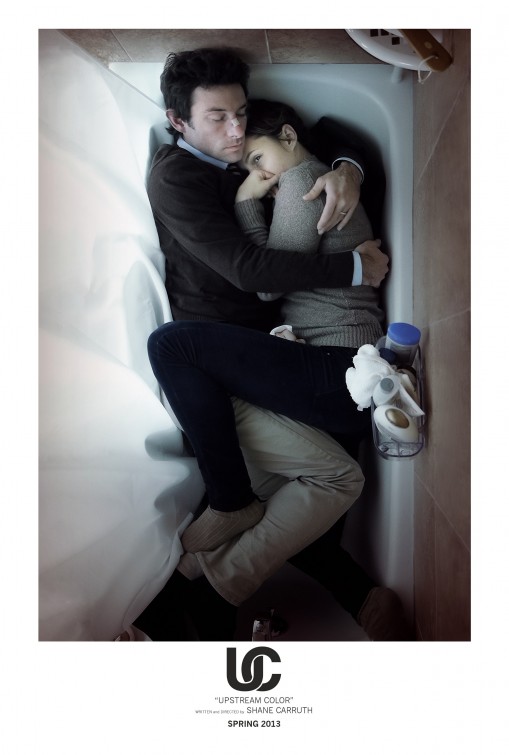
Upstream Color, available OnDemand
It's impossible to describe writer/director/actor Shane Carruth's new film, Upstream Color, without sounding ridiculous. As evidence: it's about worms that get in your bloodstream and make you susceptible to brainwashing. And pigs. And orchids. See? Ridiculous. But wade in.  You won't regret it. If you watch it at home, I recommend turning off all the lights and turning off the phone, so you can get washed away just like you would in a real theater.

What Maisie Knew, in theaters
Maisie is a little girl with terrible parents who love her in the way that utterly self-absorbed people love others. She has two beautiful, young, and kind stepparents who are caught in the torrent of these terrible parents. Some awful yet ordinary things happen to her. If What Maisie Knew (based on the Henry James novella), was told with any distance, it would be hard to watch. It's told from Maisie's perspective, however, and you're brought into her world of toy animals and fabric crowns. Grounded by a remarkable performance by Onata Aprile, as Maisie, this is the kind of portrait of childhood that I haven't seen since 1996's Ponette (another stunner, if you haven't seen it).

Things to Listen To
I do almost all of my listening on Spotify these days. The premium account is around $10 a month and allows you to listen to playlists offline. I like having a steady stream of all the music on my phone.

I Was an Eagle, Laura Marling
Laura Marling's world is one of devils and angels. It's also a world of old-fashioned-style folk music: a girl and a guitar and her declarations and confessions. This isn't any harmonizey post-Mumford stuff (although, fun fact: Marling used to date the Mumford in charge). While nothing quite lives up to my favorite Marling song, "The Beast" (which is just scary), the album, particularly it's title track has been getting a work out on my computer headphones lately.

Things to Watch (Serialized)

Covert Affairs, Season 3, available on Amazon Streaming
When I was a kid, I made up stories about a girl spy named Jamie Pond, double-oh-six. So I'm basically the target audience for Covert Affairs, a show about a young female spy named Annie Walker. I recently started watching past seasons on Amazon. Seasons 1 and 2 were decent fun, like most USA summer shows. And then season 3 broke the case-of-the-week structure in favor of a season-long arc, dealing with what it means to be a woman staking claim to power, loneliness and loss, helplessness when our loved ones are in pain. I'd recommend the first two seasons to get to know the characters - particularly leads Annie and Auggie, played sympathetically by Piper Perabo and Christopher Gorham; and Oded Fehr as the recurring character of Mossad agent Eyal Levine. Once you're all caught up, though, you'll find that Season 3 is a whole different beast - stronger, darker, and deeper.

Orphan Black, BBCAmerica and Amazon Streaming
A young, punkish woman named Sarah stands on a train platform. She watches as another woman - this one well-dressed and business-like - jumps in front of a train. But just before the woman jumps, Sarah sees that they have ... the same face. This is the high concept beginning of Orphan Black. As Sarah investigates, she begins to find other women who look exactly like her. Each woman is played by Tatiana Maslany, who has got to be one of the most talented actresses working today. Playing a suburban housewife, a hippie scientist, an insane Ukrainian - just to name a few -- Maslany pulls off an incredible string of performances. Each woman is distinct from the others, and all of them are critical to the plot. My only
quibble with the show is that sometimes it's Canada-as-New-York production values are a little sloppy. Would an American husband use "I got up early to watch cricket" as an excuse for why he wasn't in bed? Probably not, but it's easy to brush nitpicking aside when the action and characters are so brilliant.

Top of The Lake, Netflix Streaming
Jane Campion's seven-part mystery series completely gets the dichotomy of living on the frontier. Though surrounded by beautiful scenery, you're also surrounded by poverty, crime, and lack of options. Those who choose to live in that rough world are often rough themselves. The series reminds me of the Northern Idaho country where I lived as a child, but in this case, it's New Zealand's lake country we are talking about. Elisabeth Moss (yes, from Mad Men, which I have not been watching this season) plays Robin, a detective who has returned to her home town to visit her dying mother. While she's back in town, she is called in to work on the case of a missing little girl. As the mystery deepens, Robin is forced to confront her past. Sounds familiar, right? You've seen this tale before. But the setting, the acting, and of course, the Jane Campion touches of weirdness, put Top of the Lake above your typical procedural. I wish that the final chapter wasn't quite so overwrought, but you can't do gothic without some twists and family mysteries.

Things to Read

Siege and Storm, by Leigh Bardugo
Siege and Storm is the second book in Bardugo's "Grisha Trilogy," a series about a young woman living in a kind of alternate version of Tsarist Russia called Ravka. In Shadow and Bone, we learned that Alina is a wizard with a unique power. In Siege and Storm, multiple players are after that power. Alina is a likeable character to whom many a geek girl will relate. Even better, Bardugo's writing has become more lyrical and self-assured. With snappy dialogue, clearly-described action sequences, and lovely descriptions, Siege and Storm should bring the Grisha Trilogy above other similar YA novels, particularly those about glittery vampires.

TheMarySue.Com - A Guide to Girl Geek Culture
Why didn't I know about The Mary Sue earlier? It's a website about geek pop culture for girls! It's got articles about why Alice Eve had to take off her clothes in Star Trek: Into Darkness for no reason! It's my new favorite website.

Thursday, March 7, 2013

What do you get a girl for Women's History Month?


I'm not going to lie. I have mixed feelings about Women's History Month. I imagine that African-Americans feel the same way about Black History Month, and people of Latin heritage feel the same way about Hispanic Heritage Month. It's too little too late.

The Euro-centric patriarchy is saying: Hey, we know we've systematically oppressed you. We know that we've treated you as property, refused to listen to you, and under-educated you. We know that we've written a story of our country that doesn't include you. But look - here's a month where we'll put up posters you!

I kind of want to say back: Hey, take your stinkin' month.

But then again, I want to run through fields of flowers and hug my copy of Little Women in celebration.

(Insert crack about how women never can make up their minds, to put the misogynist cherry on top of the sundae of my mixed feelings).

Despite the fact that we can't erase thousands of years of oppression with 31 days of NPR stories about boundary-busting women, it's worth pausing for Women's History Month. Why? Because many think that feminism, like other equal rights movements, is no longer needed. Here are a  few things to think about, if you're not sure why we still need a women's rights movement:
  • Globally, 1 in 5 girls who are eligible are not in primary school. 2/3 of illiterate adults are women.
  • Only 12% of university physics faculty members are women. 43% of physics faculties have NO women.
  • Women are 51% of the population but hold only 18% of the seats in Congress. This is a historical high. Only 29 women in Congress are women of color. 
  • Seems obvious, but the US has never had a female president or vice-president. Countries that have had a female head of government? Pakistan, Bangladesh, Germany, Norway, Indonesia... and more
  • On ABC's Scandal, Kerry Washington is the first African-American female protagonist of a network drama in FORTY YEARS. Mindy Kaling is the first woman of color to write, produce, and star in a network sit-com. EVER.
  • Hollywood's highest earning male actor (Tom Cruise) makes $75 million a year. The highest paid female (Kristen Stewart) makes $35 million.
Even if all of these statistics eventually become equalized, will things really have changed?

Here's the thing about oppression: the oppressors write the rule book. They get to determine what it means to be successful, to be good, to be worthy. Improvements in civil rights become defined as "getting to do what the oppressor formerly kept you from doing" -- things that the oppressors deemed as valuable in the first place.

So yes, women might one day make as much money as men. And then what? The idea that money is a sign of worth has been imposed by a system created by and benefiting white men. Women might hold more political offices, but the governmental systems are all defined by the patriarchy. All our dearly-held values were determined by a system in which the voices of women and minorities were diminished.

So what does this mean, if we are seeking to be equals in a system that we didn't create? What does it mean for Women's History Month?

I don't know for sure.  I think it means that we have to say what we want, and not what we believe we should want. We need to stop judging other women. Women have to tell a lot more stories, in our own ways -- not just stories of the women who get on Women's History Month posters, but stories of our mothers and grandmothers and sisters. And then we need to shut up and listen. Because the patriarchy has determined that the person with the loudest voice is the one who gets the spoils, but there exists within us a world where the one that hears the softest voice will gain the greatest wisdom.

Tuesday, March 20, 2012

The Adorkable Feminist


Or... Feminism Part 2, a matter of definitions
(click here for Part 1)

So, the definition of feminism is this:
the doctrine advocating social, political, and all other rights of women equal to those of men.

Which is practically the least offensive thing ever, right? Unless you're Rick Santorum.

So here's the prob, Rob.
Or Roberta.
A lot of anti-feminists claim that's not actually the definition of feminism. Here's how one website defines feminism:

"♦ Feminism had nothing to do with getting the vote.
Feminism is not about equality. Feminism is about extremism.
Feminism isn't about bringing out those traditionally female attributes of nurture and care.
Feminism is about telling women what they should be and restricting their choices.
Feminism hates men. Feminism doesn't want a woman to feel loved.
Feminism is deceitful and dishonest."

Basically, they are saying that if you say you are a feminist, and you aren't a man-hating liar, then you're wrong about what feminism is. So not only are you not a feminist, according to them, you're also stupid.

(Just Google anything like "percentage of women who are feminists" and you start getting similar hate-filled rants after three or four links.)

A lot of women also believe that to claim the label of "feminist" means to claim the popular image of a humorless woman who never shaves her legs and wears cardigans covered in cat hair.

I'm here to say: I'm a feminist. And I'm adorkable.

You see, Entertainment Weekly had a whole article about the TV show The New Girl this week. It was about how some feminist critics bashed The New Girl, because Zooey Deschanel's character acts too much like a "little girl." The show's creator is a feminist, and based a lot of the character on herself. So of course, she felt pretty crap about all that.

Again, a problem of definitions. Some feminists, just like the dude above, seem to be saying that true feminists have to claim more than just a belief in equal rights. They have to be serious. They have to be adult. They don't play the ukulele.

photo source: Fox.com so ironic...

I am a feminist. I claim a belief in the equal rights of all humans. But I'm not just a humanist because I believe we live in a patriarchal society which systematically oppresses women. "Systematic oppression" does not mean that there is a group of men somewhere deciding to oppress women (although the GOP seem to be trying to give the impression that they are that group). No, it refers to the accumulation of largely sub-conscious cultural and personal acts which serve to advantage men and disadvantage women.

But I also believe that a feminist can wear sparkly shoes and make up twee songs if she wants to. God knows I do. In fact, I believe the fact that such "feminine" actions are viewed as "unserious" and "childish" is a result of said patriarchal oppression. My sparkly shoes are fighting the power!

As long as women or men make us believe that claiming feminism means also claiming the popular perception of feminism, then we've got a problem.

Friday, February 24, 2012

Feminism: It's Not the F-Word - Part 1

Le Tigre's Kathleen Hanna in her iconic
 "Feminist" sweater.
...  but obviously, many people think it is.


The past few weeks, there's been a war on women and our right to self-determination. It's all wrapped up in politics and religion and ... politics.


Here are a few things that have gone down recently:
  • When Chris Brown, who violently assaulted then- (and now-?) girlfriend Rihanna, performed on the Grammys (an event which offended many women, including survivors of domestic violence), several women tweeted that Brown could beat them.
  • The Susan G. Komen Foundation withdrew funding from Planned Parenthood and then reinstated it after there was an outcry.
  • Republican candidates have spoken out against a mandate that employers provide health care that includes birth control. In a debate, Newt Gingrich said that Obama supports "infanticide" and Rick Santorum said that we need stronger families, rather than birth control.
  • Rick Santorum (again!) said that women in combat will cause problems because men will have "emotions."
  • Michelle Duggar, the mother featured on 19 Kids and Counting,  is publishing pamphlets that advocate the key to a happy marriage is wifely submission.
  • The Girl Scouts were accused by conservatives of having a radical lesbian agenda and one California Scout called for a cookie boycott because Girl Scouts allow transgender boys who identify as girls to be Scouts. In other news, Samoas were accused of having an agenda of liberally spreading deliciousness.
  • Susan B. Anthony had a birthday! She's 192! If you listen closely, you might hear her say, "We've still got a lot of work to do!"
Obviously, in this political season, one party has decided that attacking the freedom of women is a way to be successful. And although there's been a great deal of uproar in response to each of the events described above, there're also way too many people who take these attacks seriously. Not only are they serious, they believe that suppressing women is MORAL, even the will of God.


And even though it's clear that the fight for equal rights, regardless of gender (and regardless of a whole bunch of other factors - such as race, ethnicity, sexual orientation, class, ability... ) is still going on, only about a quarter of women say they are feminists.


 This makes me sad. It makes me sad because in a world in which our country's political leaders actively and openly belittle women and their rights, women don't identify with the movement that has allowed us to:
  • vote
  • get educations and jobs
  • own our own property
  • choose who we want to marry -- or if we marry -- regardless of whether our fathers agree
  • divorce husbands who commit adultery or violence
  • maintain custody of children after those divorces
  • write, act, and produce art under our own names
  • decide how many children (if any) we want to have
  • speak out if we are harassed in the workplace
  • and that's just the beginning...
I know that this is a blog about the environment -- and some other stuff -- but I want to devote a few posts over the next week or two to the continuing battle for equal rights for all humans in our country. Because that's what feminism is all about -- equal rights. Not about hairy legs, not about hating men. It's about equality.

And in the end, many of the people (especially politicians) who do not support the rights of all humans are the same ones who don't support the movement to make our lifestyle more sustainable. It's pretty amazing -- when it comes to a philosophy of caring - for people, for the planet -- one side is curiously silent. They advocate for a Darwinian vision of survival of the fittest.

Oh wait. They don't actually believe Darwin knew what he was talking about...