For about three weeks I've been meaning to blog about a fabulous dining experience I had recently in Denver. I was there for work, and one of my colleagues who lives in the city took us to Root Down for dinner.
I love this restaurant's philosophy:
Root Down aims to connect the neighborhood to a dining experience in the same way ingredients are connected to food. There should be a seamless bond between the elements and experience, which stimulates the senses and draws people in.
They use as many seasonal, local, and organic ingredients as possible.
Oh... and the food is delicious.
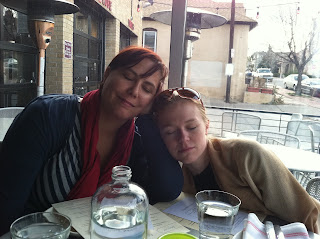
Alice and I are super-excited about the tapas-style meal we are about to have. (My friend Edlyn is there too; she's behind the camera)
Beet gnocchi! Why isn't this available everywhere? So much better than regular gnocchi.
Cheese plate. Everyone I work with is serious about cheese. This plate contained one of my all-time favorite cheeses: Barely Buzzed. Yes. I am that food nerd who has a favorite artisan cheese.
We also each had a slider: Edlyn and I had duck, and Alice had vegetarian. Gotta love tiny sandwiches.
For dessert? Pot de creme!
And then Alice and I were exhausted from a long day of traveling, work, and eating.
One thing I don't know: Did the restaurant get its name from the Beastie Boys classic?
Every Tuesday when there's a new episode of Glee, I invite a group of friends over and we have "Glee-tini" night. We drink cocktails and watch Glee, commenting about the musical numbers, trying to spot our favorite dancers from So You Think You Can Dance, and generally having a pretty ridiculous time.
Tonight, however, I found that I was blinking back tears in the midst of the hilarity.
Why? you ask. Well, tonight's episode focused on accepting yourself, just like the Lady of Self-Acceptance, Gaga, exhorts in her song Born This Way. One of the characters, Emma, found that to learn to accept herself, she had to come to terms with her own anxiety disorder.
To paraphrase, her doctor told her, if one of the students you work with had diabetes, you would tell them to use their insulin; so why won't you take the medicine that will help you regulate the chemicals in your own brain?
I was teary-eyed because years ago, I went through the exact same thing, and used the exact same analogy (down to the diabetes reference) to convince myself to come to terms with the fact that my brain doesn't work quite right, and I have to work to keep it regulated. That involves a combination of medication, exercise, and visualizing my happy place.
Coming to terms with a mental illness involves pushing through the strictures of a society that places a premium on mental toughness. You aren't supposed to admit you ever get sad, mad, or tired. I mean, come on, we live in a country where the standard greeting is: "How are you?"
And the expected answer is "Fine, how are you?"
There's also a perception that if you take medication for a mental illness, you're somehow masking your true self. Well, I can tell you, my mental illness kept my "true self" squashed down deep.
Deep down, I'm not a person who curls up and cries on a couch, or who shuts down in the face of interaction with strangers. But that was the person my anxiety disorder made me.
The person I was born to be? That person was born to fight tirelessly for the welfare of children. Born to find family members wherever I land in life. Born to create, dance and laugh.
I know that I have friends out there (some "in real life", some virtual) who haven't yet come terms with the fact that mental illness is a real illness, and we are blessed to live in a time when we can conquer it and be the people we were born to be. To them, I send this hope: to realize that mental illness, like diabetes, doesn't have to stop you from being who you are.
It's Glee-tini night, so if you can't listen to me, listen to Pink, and raise a glass to everyone different from the status quo ('cuz you're wrong in all the right ways):
This is one of those really easy recipes that is great for people who aren't feeling too sure about meatless meals. It's also the kind of recipe where you don't have to be too picky about quantities or amount of cooking time.
Ingredients
1 large can of enchilada sauce (red or green, your choice)
a package of 10 tortillas (flour or corn, your choice). Use a pizza cutter to cut them into strips about 2 inches wide
Olive oil
8 oz. seitan (this is an alternative protein made from wheat gluten. You can usually find it next to the tofu. It behaves a lot like chicken. You could use other alt-proteins if you want, or just skip it).
2-4 cloves garlic, pressed or minced
An onion, chopped
Cumin, red pepper, cayenne, salt and pepper
A big bunch of spinach, chopped
Some mushrooms, sliced (I got the spinach and the mushrooms from the Farmer's Market - hooray for locavoring!)
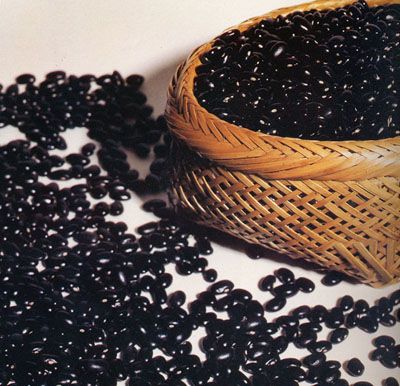
1 can black beans
Shredded cheese (skip this to make a vegan version)
Step 1
Pre-heat the oven to 350 degrees. Coat the bottom of a 9x13x2" baking pan with about 1/3 of the enchilada sauce. Set aside.
Step 2
Chop the seitan into small pieces. I chopped it pretty small for more of a "ground beefish" effect, but you could chop it into larger pieces for a more "chickenish" effect.
Step 3
Add a small amount of olive oil to a skillet and put on medium-high heat. Add the garlic and onion, and saute until soft. Add the seitan and mushrooms. Season with cumin, red or cayenne pepper, salt and pepper until it is how you like it. Stir occasionally.
Step 4
When the mushrooms are soft, add the spinach (I had to saute it separately because my pan wasn't big enough). Saute spinach until just wilted.
Step 5
Layer the tortilla strips on the enchilada sauce on the bottom of the pan. Then cover with about 1/3 of the seitan mixture, and 1/3 of the beans. Cover with tortilla strips and enchilada sauce. Continue layering until all of the ingredients are used up. Finish by sprinkling with cheese (remember, skip that step if you're going for vegan).
Step 6
Bake, covered, for about 30 minutes, or until the sauce is bubbling and the cheese is melted. Uncover and put under the broiler for about 3 minutes to brown the top. Remove from the oven and let the casserole rest for about 5-10 minutes.
* Meatless Monday - a movement to increase awareness of greener eating by encouraging people to eat meatless every Monday.
A couple of weeks ago, I went to the movies with a couple of friends, and when we sat down I distributed some bags of trail mix and chocolate pretzels to everyone. (Yes, I realize this makes me seem like a soccer mom.)
My friends went on and on about how delicious it was.
"It's from the bulk area," I said.
My friend misheard.
"It's from Bulgaria?"
So now, I think of the bulk area as "Bulgaria."
Bulgaria is my favorite part of the grocery store. Stores with small Bulgarias? They just upset me. As processed foods have come to prominence, it seems like most stories have given up their bulk sections, or cut them down to just a few bins of peanuts. But a good bulk section can cut your costs and your waste.
In fact, it can even cut your waste to a couple of handfuls a year, as this California family shows:
What I want to know is, where did they get bulk wine?
I have so many thoughts bumping around in my head right now, and so many things I'd like to share (a recipe for an Enchilada Bake, stories about a trip to Denver, my encounter with processed foods). But I've been too busy, so I'll just show you a few pics from this weekend's trip to Girl Scout camp instead.
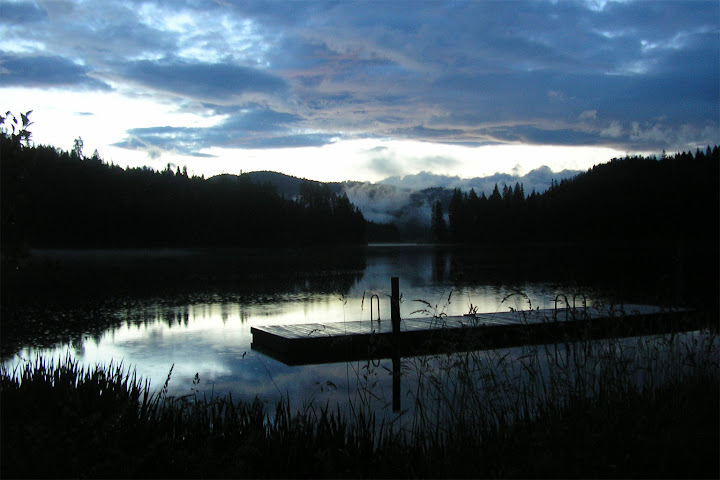
FYI - This is Camp Agnes Arnold, an absolutely beautiful camp, as you can see below.
I'm at Girl Scout camp this weekend, so I thought I would re-run this favorite piece about why every kid needs camp.
I know a little girl, whom I'll call S.
S. is an insect whisperer.
S. is just finishing second grade. She goes to school near Houston's ship channel, a neighborhood surrounded by warehouses, silos, and parking lots for tractor trailers. The neighborhood is mostly Hispanic, and its population is shrinking, crowded out by industry. School is not really S.'s "thing", and she has to work hard at her studies.Nevertheless, she is fearless, possessing a deep understanding of the natural world - an understanding which extends to a sixth sense about how to approach wild things without scaring them off. Butterflies and "roly-polies" grow immobile and quiet as S. nears. The picture above shows S. as she has a close encounter with nature at Girl Scout camp this past weekend.
S. is one of the reasons all children need camp.
I worked at a summer camp (YMCA) for 8 summers - much longer than is reasonable for an adult person. I had an idea, at that time, that camp was really good and important for kids. After all, it had been for me. However, in the years since then, I've come to believe that camp, or something akin to it, should be an integral part of the educational experience of every child, particularly in an era when sustainability is crucial to our survival.
For S. and most of the kids who go to her school, "nature" consists of the school garden, chickens which roam the street around the school, and occasional field trips. At the school where I taught, nature was represented by the yearly termite swarm which drove my class out of the school, and the dead cockroach I nicknamed "Sketchy" (because it was sketchy that he lay in the school hallway for a week.) Now, let's face it, lack of access to the natural world is not only a problem of the inner city. A man-made lake in suburban Houston doesn't really count as "nature." However, as with many problems, income inequality compounds the issue. Not only do kids like S. have few chances to encounter the natural world in their daily lives, but their families have few resources to provide such encounters. Camp (Girl Scout, Boy Scout, YMCA, YWCA, school-sponsored, church-sponsored ...) can provide those opportunities for kids - if we make a conscious effort to include kids like S.
So why does it matter?
Here are a few reasons why I think camp is as critical as school in fostering the next generation:
1) Camp, most obviously, gives kids opportunities to interact with the natural world. Now, we all know that kids don't get to go outside and play as often as they should -- and there are a number of reasons for this. Parents are afraid of the unknown, kids are hooked on video games, teachers give too much homework ... the list of targets for blame could go on and on. And while I don't go as far as to say that kids have "nature-deficit disorder", I do think that kids who don't get to experience the wilderness miss out on a vital connection with the world around them. If you've never seen a frog in the wilderness (or gone frog hunting at night, catching frogs and then letting them go), hearing about massive frog extinctions won't mean much to you. And if you've never seen the Milky Way glowing palely in the summer sky, it won't even register when you hear that light pollution has made it impossible for many Americans to see the stars. Kids who are going to be in charge of our sustainable future should have a good idea what they are sustaining.
A picture from the camp I attended and where I worked for 8 summers.
2) Camp fosters innovation. At the camp where I worked for all those years, "building stuff" was a routine part of any week-long session. Inevitably, someone was going to take a bunch of 9-year-olds (boys or girls; it didn't matter - camp also fosters a relaxing of traditional gender roles, but that's a whole other blog) into the woods, and the group would find logs, branches, ground cover, and build a temporary shelter. Hiking around weeks later, one would find these abandoned palaces here and there, remnants of kids' ingenuity. Throughout the week, campers dressed in costumes, blazed trails, wrote songs, performed random acts of kindness, spoke like pirates, crawled on their bellies through grass pretending to be Scottish warriors, and created crop circles. Yes, their counselors had a lot to do with inspiring these bizarre behaviors. Kids, however, learned that their true selves might be a little different than what they had believed before. The future is going to demand innovative solutions to a host of problems that we have created. I want to live in the world where the engineers of tomorrow have built crazy shelters in the woods.
3) Camp bolsters independence. True story, the first time my parents dropped me off at camp, they had to leave me crying in the middle of the road, I so didn't want to go. But I had won a scholarship, and so I had to go. I wanted to be with my parents, where I knew what to expect. At camp, I had to make decisions. There, kids decide what activities to do, what songs to sing, what to wear in the morning, how long to brush their teeth, and if they're going to shower. They learn that attitude has an impact on the course of the day. And they have to get stuff done - set tables, sweep under bunks, clean up after themselves. Camp is a microcosm of society (albeit a society where you get to sing at the table and eat without silverware) in a way that school just isn't. School, in many ways (and I say this as an educator) is about learning to conform. Camp is about learning to take responsibility. We're going to need responsible, community-minded citizens to take charge and make the sacrifices that are going to be necessary in the coming decades.
4) Camp teaches whimsy. The other day I gave a friend a photo I'd had for many years. In it, he was dressed in a flowered muumuu and a broken sombrero, while beside him a girl frolicked in an orange drill team uniform and pink snow hat. Now. Ahem. Whatever was happening in that photo, which might have been conceptualized by Salvador Dali on crack, does not directly have any bearing on sustainability. However. I think whimsy is going to save us. Silliness is as sustaining as recycling. It builds connections between people and calls on brain cells we don't usually get to access. For this reason alone, every kid should get to go to camp.
So, what do we do?
Well, we can do stuff like giving our yearly charitable contributions to organizations which sponsor camp or wilderness experiences for low-income kids, voluneer with organizations such as Girl Scouts and YMCA, and fight legislation that would end summer break and extend the school year. And we can continue all of the sustainable practices we attempt to keep up day-to-day, in order to preserve the wilderness for the next generation.
For about the last year, I've been using Dr. Bronner's Organic Castile Soap (in lavender). Castile soap is olive-oil based soap, and greenies everywhere tout the fact that it has few harmful chemicals and can be used to clean almost everything -- you, your hair, your baby, the floor, the bathtub, your laundry. (Click here for more about it's many uses.)
I was anxious to try it, but my first encounter didn't go well. It was a grocery-store brand, and it smelled like death.
I swore off castile soap until I visited my friends Sara and Ron, and they had some Dr. Bronner's in their shower. Yum! It smelled delicious. Not like death at all. When I got home, I got myself some.
You may have seen Dr. Bronner's at Target or the grocery store, and you might have dismissed it. It doesn't exactly jump out at you from the shelves. Dr. Bronner's is known for two things:
1) An incredible lather from only 2-3 drops, meaning that a bottle lasts a lo-o-o-ng time; and
2) The labels are covered with teeny-weeny writing. What does that writing say? Well here's a sample:
Yep. That's Rudyard Kipling's poem, If. Turns out Dr. Bronner was a bit of a kook. He believed in the "All-One-God Faith" and something he called the "Moral ABC". He used his soap labels to spread the word. Now, the labels are as famous as the soap.
All I know is, I love my Dr. Bronner's. The castile soap is great, but almost better is the hand sanitizer. While hand sanitizer isn't necessary for most folks (who really needs to contribute to antibiotic resistance in bacteria?) for someone who goes into random classrooms all the time, "hanitizer" is a necessity. Whenever I bust out the Dr. Bronner's, people say "Oh... that smells good!" as opposed to saying, "Oh... are you squirting gin on your hands?" Knock wood, I haven't gotten sick since I started using it.
Interested in hearing more about Dr. Bronner? Watch below:
If you read food blogs, you've probably come across someone who rhapsodizes about the now-famous Tomato Sauce with Onion and Butter. It's a recipe that could not be simpler - canned tomatoes, an onion, butter. I know several people who are obsessed with it. I mean, why not? It's a recipe with three ingredients that tastes delicious.
I have my own similar obsession. It's a recipe that I make whenever I can't think of anything else to eat, when I need some comfort food, when I want to eat something really delicious, or basically any time.
Now, it's not the greenest recipe because all of the ingredients come in cans. But then again, cans are recyclable. And this recipe is vegetarian, and you can make it greener by buying the organic canned black beans.
It is ... Chipotle Black Beans!
(I usually use them to make bean tacos, which are my favorite food on earth, but you can use them as a base for soups, an enchilada filling, a side dish, or just slap them on a tortilla and eat).
Chipotle Black Beans
Ingredients:
2 cans of black beans
1 can of chipotle peppers in adobo sauce (I like to use the San Marcos brand).
Step 1:
Open the cans. Drain one can of the beans and don't drain the other one.
Step 2:
Put the black beans in a pot. Add some of the chipotle peppers to the beans and stir. How many peppers you add depends on how much you like spiciness. If you don't like things too naughty, just add 1 or 2 peppers and a little of the sauce. If you're a real champion with an iron stomach, add the whole can. I usually add about half the peppers and as much sauce as I can scoop out.
Step 3:
Place the pot over medium-high to high heat. When the beans boil, reduce heat, cover, and simmer for 10 minutes.
Step 4:
When you uncover the pot, you'll probably see that the peppers have inflated and floated to the top. Scoop these out and discard. Re-cover and simmer for 25 minutes or more.
Step 5:
Remove the pot from heat. Uncover and let rest for about 5 minutes. The beans should have sort of a gummy, sticky, gooey texture. Awesomeness. That's it! You're done!
How to make bean tacos:
When I was a teacher, a lot of my students' moms made brought their kids bean tacos for lunch. My favorite days were when one of the mom brought me some too! This recipe is inspired by those lunches.
Heat some oil in a pan. Fill a flour tortilla with chipotle black beans, smashed avocado, and some shredded cheese. Put in the pan and heat, flipping once. For a mind-blowing experience, sprinkle a little shredded cheese on the outside of the taco, pre-flip. Flip it very fast, to have a crispy cheesy delicious coating on your tortilla.
* Meatless Monday - a movement to increase awareness of greener eating by encouraging people to eat meatless every Monday.
One time, I was in the grocery store and I overheard this little dialogue:
Girl (about 3, wearing a tutu and pointing at Fruit Snacks with Disney Princesses on the packaging): Can I have that? Princesses!
Dad (British-accented): You see, they put the princesses on the box to make you want to buy it. There's not really any princesses. It's called advertising.
Girl: I want the advertising!
Kudos to dad for beginning to teach his daughter, at an early age, to be media literate. (Kudos also for letting her go to the store in a tutu).
I was reminded of that scene when I watched this TED Talk* by a cool 11-year-old who's learned to buck the system.** No "sparkly" cereal for him!
* TED is a non-profit devoted to "Ideas Worth Spreading." They hold events where people give amazing talks about ... all kinds of things. If you ever need inspiration, ideas, or a kick in the pants, visit the TED site for videos of these short speeches.
** And yes, I found this video through the Ian Somerhalder Foundation website. Just proving once again, that if you want to learn about the environment, watch The Vampire Diaries.
At Christmas, my mom and I were both staying at my sister's house. One morning, my mom and I woke up before the rest of the fam and were chatting.
When my sister got up, she plopped down on the couch and listened to us talk for a minute.
"You're talking about food again!" she exclaimed.
Yep.
Food. It's sustenance, it's tasty, and it's our key intersection with "living green."
The more I write this blog, the more I'm convinced that our food choices are our most important way of being "green."
A big part of eating green, or course, is reducing meat consumption. I don't know if I'll ever be a "real" vegetarian, but this blog project has only increased my 17-year-commitment (gee, that means I'm old!) to not eating mammals. Currently, I cook fish or poultry once a week, and eat a vegetarian diet the rest of the time. You might wonder why, when my meat consumption is so low, that I don't go strictly veg.
The truth is, I just like to have poultry or fish every now and again. I don't have a moral problem with eating meat. I do, however, think that those of us in the western world need to make deep cutbacks in our consumption of animal products and start farming and producing them in ways that make better sense for the environment and for our spirits.
As I've mentioned before, my friends and I have created a vegan cooking group, inspired by Alicia Silverstone's Kind Dietcookbook, to experiment with more earth-friendly ways of eating. All of us in the group have long-term commitments to diets that are low-meat (one flexitarian - that's me; one pescatarian; and one vegetarian), but none of us are vegans.
We meet up regularly to try out vegan recipes.
One of our biggest successes was Pecan-Crusted Seitan, from Alicia's cookbook.
This is one of those vegan dishes that you would absolutely never guess is vegan. It's delicious, elegant, and did I mention delicious?
We also tried this Red-Lentil Thai Chili from the Post-Punk Kitchen website. It's one of those recipes where you just feel like health is flowing to you from your spoon -- but not in a gross, wheatgrass kinda way. In a delicious, I'm eating a velvety lime-infused sweet potato kinda way.
Have you tried any green cooking adventures lately?
OK, there's no doubt, the greenest way to read is to go to the library and borrow books.
I'm not gonna lie. I don't do that.
Why? Mostly because I like to write in my books and go back to my favorite passages over and over again. As someone who spends a lot of time thinking about how people learn to read and think about what they read, hunkering down with a book I can't write in just seems silly. Most of my books are read, re-read, loaned and loaned again. They get a lot of use.
(Plus I think library books smell weird. Yep. I'm shallow like that.)
On my recent vacation I didn't want to take a whole backpack full of heavy books, and I decided to put some of my birthday money to use by getting a Kindle.
As soon as it arrived, I was instantly smitten. It's light, attractive, and the display is amazing.
See:
Any blurriness is due to the fact that I took this picture with my phone. Still, pretty amazing, no?
A few advantages:
You can carry around lots of books at once, duh.
They have "Kindle Active" books (like crossword and puzzle books), so you're not wasting more paper with those. I do a lot of crosswords, so I'm saving paper this way.
Magazines are available. Of course, the Kindle isn't in color, so some magazines wouldn't be as satisfying in this format. However, for text-heavy magazines like the New Yorker or Atlantic, this seems like a good option.
The e-ink only uses power when you turn the page, so the battery can last for a LONG time (over 2 weeks). Hooray for using less power. Techie devices usually draw a lot of power (the iPad battery reportedly lasts up to 10 hours).
The screen has a nice matte finish, and you can read it outside with no glare.
Since books are downloaded directly to the wifi-enabled device, you're not driving anywhere to pick up books, nor are fossil fuels being used delivering them to your house.
But is an e-reader really greener? It may seem like it at first thought -- I mean, you're not using any trees, so it must be, right? But of course, the manufacture of an e-reader involves a lot more toxic materials than a book. I've read different estimates of how many books you have to read over the life of your Kindle to make an even ecological trade-off with printed books. These estimates vary from 22 to 100. (Here's an article about the greenness of e-readers vs. books if you want to know more).
So the key is, don't buy an e-reader if you're not already someone who likes to read. But if you are, I've found it to be a great option.
(And what am I reading right now, you might wonder? I'm glad you asked. I'm reading The Thousand Autumns of Jacob de Zoet, by David Mitchell and I LOVE IT. The Kindle doesn't have pages, of course, but there's a little bar at the bottom of the screen that tells you how much you've read so that you can get that satisfying feeling of making headway through a book. In two days I've read 34% of this book. Apparently it's 512 pages long in the printed version, but it flies by. Don't be intimidated by the length and David Mitchell's reputation as a literary trickster.)
Have other questions about the Kindle? Let me know.
Is March gone already? I am not exactly sure where those 31 days went.
At the beginning of the year I created a list of goals for 2011, which you can read by clicking here. Here's how I'm doing on them so far.
Learn:
Learn to knit lace. I'm still working on the same &^*#@$ lace sweater that I wrote about at the end of February. Each time I think I've got the lace figured out, I ruin it. At the risk of jinxing myself, I think I might have it this time.
Improve my Spanish. I did! I went to Spain and said things in Spanish - like, la cuenta por favor (the check, please); or un cafe con leche. All kidding aside, being in Madrid, even for a few days, made me more confident to at least try to say things aloud. Luckily I was with my friend Katie, who could help me out a lot.
Go:
Did I mention I went to Spain?
There it is again. Spain. This is the Sagrada Familia.
I also have a goal of trying one new restaurant a month in my home city. My friends Keith and Kelly invited me to breakfast at The Country Kitchen for breakfast. This is exactly the sort of place you should go for breakfast -- the floor's a little sticky and it's kind of in an industrial neighborhood. The coffee was great diner coffee and they kept it hot and refilled. I would totally recommend it as long as you're not overly-obsessed with cleanliness.
Do:
Exercising more has been my main focus from the "do" part of my list. For most of March, I was pretty good. On my trip, we probably walked 3-5 miles per day (although I gained weight because Europe = cheese. But it was worth it.) I've started doing yoga again, which I'm really enjoying. Yoga is something I grew up with; it's been fairly constant throughout my life, but I would say the last three years I haven't been up on my practice. I'm also walking fairly regularly. In April, I want to try to keep track of my exercising a bit more, in some way that doesn't make me actually hate exercising.